
Concept, Theories and Types of Intelligence
Understanding the Concept of Intelligence
Termed as Buddhi, Viveka, and Manas in ancient Indian philosophy, intelligence has always held a central place in how we understand human consciousness and potential. Yet, the concept itself remains open to interpretation. Ask five different people what makes someone intelligent, and you will likely receive five distinct answers.
For some, intelligence is synonymous with academic success—cracking high-stakes competitive examinations such as JEE MAINS, NEET, NET, UPSC, or SSC. For others, an intelligent person is simply a knowledgeable individual who holds an impressive repository of facts. Still others define it as creative problem-solving: the ability to think outside the box and propose novel, efficient solutions to everyday challenges.
To establish a clear baseline, the Oxford Advanced Learner’s Dictionary defines intelligence as “the ability to learn, understand, and think in a logical way about things; the ability to do this well.”
In psychological terms, however, intelligence extends beyond mere logic or memory. Psychologists generally define intelligence as an overarching capacity: the ability to acquire and apply knowledge, adapt fluidly to novel environments, think abstractly, and solve complex problems effectively across varied real-world contexts.
Information> Knowledge> Intelligence
To understand intelligence, it helps to look at how human understanding evolves across three fundamental levels:
- Information: Raw, organized data and isolated facts—such as knowing that a specific competitive exam exists or memorizing a dictionary definition.
- Knowledge: The contextual comprehension, synthesis, and meaningful connection of that information—understanding how concepts work and how facts relate to one another.
- Intelligence: The active, practical application of knowledge—the ability to reason, adapt to unfamiliar situations, make sound decisions, and solve complex problems effectively.
In short, information is what you gather, knowledge is what you understand, and intelligence is how you apply that understanding to navigate the world.
Key Theories of Intelligence: From Single-Factor to Systems
Over the past century, psychologists have debated whether intelligence is a single general ability or a collection of distinct cognitive capacities. This debate has given rise to two major theoretical perspectives: Psychometric/Factor Theories and Cognitive/Systems Theories.
1. Psychometric & Factor Theories
Spearman’s Two-Factor Theory (1904): Charles Spearman proposed that performance on any intellectual task relies on a general mental ability factor (g), which underlies all cognitive performance, as well as specific factors (s) unique to individual tasks (Spearman, 1904).
Cattell-Horn-Carroll (CHC) Theory: Raymond Cattell and John Horn divided general intelligence into two core components: Fluid Intelligence ($G_f$)—the biological capacity to think logically and solve novel problems independent of acquired knowledge—and Crystallized Intelligence ($G_c$)—accumulated knowledge, vocabulary, and skills gained through education and experience (Cattell, 1963).
2. Cognitive & Systems Theories
Gardner’s Theory of Multiple Intelligences (1983): In his seminal book Frames of Mind, Howard Gardner argued that human intelligence is not a single entity measurable by a standard test, but rather a spectrum of distinct, independent intelligences (Gardner, 1983).
Sternberg’s Triarchic Theory (1985): Robert Sternberg defined intelligence through three distinct sub-theories (Sternberg, 1985):
- Analytical (Componential): Abstract reasoning, evaluation, and academic problem-solving.
- Creative (Experiential): Synthesizing existing knowledge to deal with novel situations and generate fresh ideas.
- Practical (Contextual): Adapting to, shaping, or selecting everyday environments (“street smarts”).
Howard Gardner’s 8 Types of Intelligence
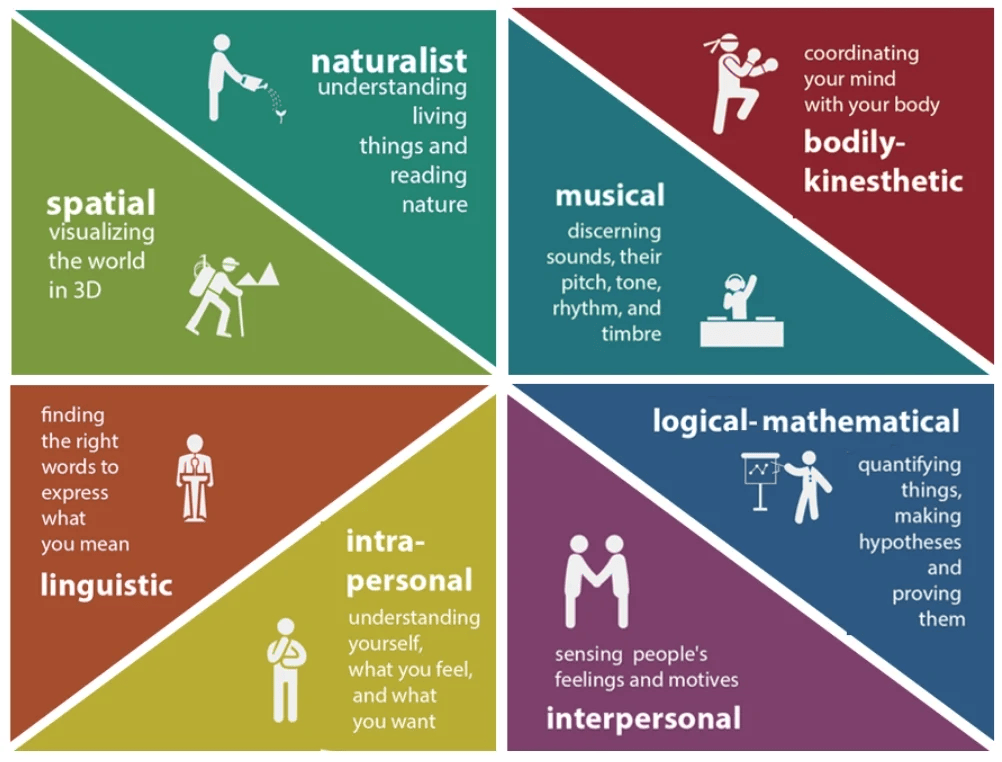
| Type of Intelligence | Core Capabilities | Common Career Paths / Profiles |
| Linguistic-Verbal | Mastery of spoken/written language, vocabulary, and argument building. | Authors, journalists, lawyers, public speakers |
| Logical-Mathematical | Logical reasoning, numerical problem-solving, and scientific analysis. | Mathematicians, scientists, engineers, coders |
| Spatial-Visual | Mental visualization, spatial orientation, and pattern recognition. | Architects, artists, pilots, graphic designers |
| Bodily-Kinesthetic | Physical coordination, fine motor skills, and body control. | Athletes, dancers, surgeons, craftspeople |
| Musical | Sensitivity to rhythm, pitch, melody, timbre, and musical composition. | Musicians, composers, sound engineers |
| Interpersonal | Understanding others’ emotions, motivations, intentions, and social dynamics. | Therapists, leaders, educators, salespeople |
| Intrapersonal | Self-awareness, deep understanding of one’s own emotions, goals, and values. | Philosophers, psychologists, writers |
| Naturalist | Identifying, classifying, and understanding elements of nature, flora, and fauna. | Biologists, botanists, environmentalists |
Modern Frontiers: Emotional and Artificial Intelligence
As our understanding of human performance evolves, the definition of intelligence continues to expand beyond conventional cognitive boundaries:
Emotional Intelligence (EQ): Popularized by Daniel Goleman (1995), EQ encompasses self-awareness, emotional regulation, motivation, empathy, and social skills. Modern research repeatedly demonstrates that a high EQ is often a stronger predictor of effective leadership, workplace success, and personal satisfaction than IQ alone (Goleman, 1995).
Artificial Intelligence (AI): Advances in computer science mimic cognitive processes like pattern recognition, automated learning, and data-driven decision-making. While AI excels at processing vast datasets and optimizing analytical tasks, human intelligence remains distinct in its capacity for true empathy, nuanced contextual awareness, creative intuition, and moral judgment.
References & Further Reading
- Cattell, R. B. (1963). Abilities: Their structure, growth, and action. Houghton Mifflin.
- Gardner, H. (1983). Frames of Mind: The Theory of Multiple Intelligences. Basic Books.
- Goleman, D. (1995). Emotional Intelligence: Why It Can Matter More Than IQ. Bantam Books.
- Spearman, C. (1904). “General Intelligence,” objectively determined and measured. The American Journal of Psychology, 15(2), 201–292.
- Sternberg, R. J. (1985). Beyond IQ: A triarchic theory of human intelligence. Cambridge University Press.
- Thurstone, L. L. (1938). Primary mental abilities. University of Chicago Press.
 AANCHAL ARORA